Friday, August 27, 2010

Nomad & the Raja

Om Pieter is 71 now and lives a modest and serene life on the outskirts of Jakarta. He has shaped his future exactly according to his aspirations. Happily surrounded by his family, his children and grandchildren. Om tends his garden daily and prides himself in maintaining the most beautiful garden in the dessa. His daughter Ida has her fathers' green thumbs and learned his tricks to grow even the most obscure plants. "You just have to talk to the flowers." he says, "They sense it". "Sometimes the villagers wonder if Ida is all right when she tends the garden and whispers sweet nothings to the flowers", he continues with a smile.

But sometimes the villagers also come to his garden, just to ask if they can sit in it for a while. Even his garden has become a haven it appears. A safe haven from much of the madness that Jakarta is facing nowadays. "Much can be criticized about Suharto's 'Orde Baru', but there was no crime, drug addiction and violence. Not like now at least. Poor people are becoming poorer and poverty is a dangerous infliction." He tells me of home made poor people drugs concocted from cheap chemicals and anti-mosquito repellent and of increased child abuse and human trafficking paradoxically coinciding with increased religious fanaticism.

"Sometimes I wonder if the people are ready for the increasing liberties they are getting." I try to reflect from a broader global perspective and say that the process of democratisation is inevitably the only way for a nation to rise above it all. But realise that doesn't mitigate the hardship of the moment. Om doesn't simply look at the politicians to enable change. He feels change starts from within and with yourself. So when he sees anything he finds intolerable he feels perfectly at home enough to challenge his neighbours.

One such thing is parents balancing babies and little children on their motorcycles and scooters. Just in the street in front of his house there have already been many fatal and near fatal accidents. Also pedestrians are often lucky to cross the street unharmed as cars might stop, but scooters and motors usually do not. Fiercely critical of these unsafe traffic practices he tells his neighbours off and doesn't accept "Insha Allah" as an answer. Sometimes Ida tells him to be careful, as in any case he is still the only Christian in the village.

I reply by saying that I believe that these things are not really a case of religion. But more a case of culture and mentality. I think that how ever much Om Pieter has emerged himself in Indonesian life he still is and always will be an Indo-European and he will always have a mind endowed with western styled critical thinking. In a moment of reflection Om Pieter looks into the distance and seems to agree. He says: "I have always tried to teach my children to practice critical thinking." "Sometimes you must accept what can not be changed. But you have to learn which is which."

With that said he starts sharing anecdotes of discussions with his children's and grand children's teachers who's only argument was: "Ada besluit dari kantor." Amused he adds: "...and yes 'besluit' (pronounced besloo-eat) is still an official Indonesian word." ('Besluit' is the Dutch word for decision.)


***

So there I am in a late Jakarta sub-urb evening with too many questions and too little time. For hours Om Pieter and I sit on the porch and chat the night away, undistracted by the occasional mosquito attack. Around midnight Ida bids us goodnight and goes to bed. "Selemat tidur." A young and older Nomad continue their animated and contemplative conversations until the night slips into the early morning.

"Why did you ever decide to go back to Indonesia?", was one of my first questions. "Why?" he says and his eyes betray the obvious simplicity of the answer to my question. "I never wanted to leave." "I cried for weeks when my father decided to leave Indonesia." "I was a young child then and I had experienced a freedom here that I never again felt in the Netherlands. I knew every backstreet, every street corner's nook and cranny of our home town of Semarang."

"One day I just had enough", he says firmly."Living in an apartment complex, but not knowing anyone. Standing in elevators either at home or in the office and no one exchanging a word. I tried. I tried to connect, tried to talk to people, but to no avail. One day I just could not take it anymore and I just started to take the stairs. My work as an illustrator also started to reflect my frustration." For Om it all became crystal clear. "I thought deeply what I wanted from my life and if I wanted to end up an old man alone in a retiree home still surrounded by strangers. No! It was time to go."

 "Oh... my sisters were so mad at me for leaving", he says with a smile. "You have a great job here in the Netherlands, they told me. But once I finally settled in and they visited me they saw it was all right. Especially Cobi often visited me. I never knew what your Grandpa, my oldest brother thought of it. He was such a quiet and introvert man you see. Much like my sister Loulou, who was also too inapprehensible to me." (The sister married to an Indonesian Ambonese man and the only one of my great grandparents children that had never left Indonesia.) "I think my younger brother was the only one that for a while contemplated following me here."

"The first half year in Indonesia I spent on Ambon the home island of our family. The resident Raja of Passo was a governmental official on Ambon. You know that we descend from the Raja of Passo right? Although I told him I just wanted to explore the roots of my family, he was afraid that I would claim our lands in Passo. He was somewhat of a gambler and had sold off much of our ancestral lands. We believe that he arranged for my extended visa application to expire forcing us to leave Ambon."

"My time on Ambon was beautiful though. Unlike when I came to Jakarta and really had to adjust and climatise, on Ambon I immediately felt at home. I found our families 'Pela' village of 'Batu Merah' and made many friends there. Life was perfect. Just imagine sailing into the ocean to fish and afterwards grill and eat the fish on the beach. Until very recently I even had a house there on 'Pantai Rumah Tiga'. My friends and I built a house of stone and wood on the beach. Sadly it was destroyed during the civil unrest a few years back. The only awkward thing sometimes was the extreme 'hormat' I received for being of Raja descent. " When Om arrived in Jakarta from Ambon due to the expiration of his visa he decided he could not leave Indonesia and simply stayed put in Jakarta. He remembers staying at home the first 3 months just reading newspapers and studying 'Behasa Indonesia', before venturing into down town Jakarta. The Raja now took the simplest of jobs as a street vendor, selling comics. But that first night in Jakarta's urban jungle, squatting in 'jongkok' position, having a meal with the street hawkers and chatting with his fellow street vendors he knew he was home. This was almost 25 years ago.

Om eventually made a living as a painter and illustrator, build a home and surrounded himself with a family that adores him. A few years back his wife passed away. But the loving family he always wanted around him in the winter of his life is right there beside him.

A Nomad cant but admire his exceptional relative.

Nomad in Jakarta

Dadang my Sundanese 'Sopir' drives a mean ride over the new highway connecting Bandung to Jakarta. After just a few hours we are almost there and make pit stop to refuel our car and ourselves. I get 2 'teh botols', bottled sweet jasmine tea and he gets us 'pisang sale', dried banana krupuk, fried and layered with cheese. Reborn we undertake the second leg of the journey.

But the moment we actually arrive in Jakarta the trouble begins. 'Kantor' Jakartans finish working around 16:00 and we get stuck in some seriously tedious traffic. Too many people owning a motorised vehicle and too few roads to accommodate. Sounds like the situation back home. With no means to escape the urban madness we move slower and slower through this skyscrapers' jungle.

Jakarta is Indonesia's capital with a population that by far exceeds the total number of people living in the Netherlands, a country considered overpopulated. It's the country's governmental, financial, judicial, political, academic, media and whatever else you can think of center. Long ago it was established as Batavia, the business and colonial headquarters of both the VOC and Dutch East Indies.
.
This is the place my 'opa' used to work for both the Dutch home and later foreign office and the birthplace of my father. The place where they embarked the cruise ship Willem Ruys, later known as the Achillo Lauro, to repatriate to the Netherlands in the 50's and begin a new life far away from their land of origin.

Nowadays the city has continued to shoot into superlatives. Not all good, but not all bad either. Om Pieter however later tells me that in the last 10 years even the quietest of outskirts have become overpopulated and the peace and tranquility he enjoyed in his 'dessa' on the borders of Jakarta city have almost disappeared. The metropolis of Jakarta is not necessarily representative for the rest of Indonesia and Jakartans are a different people all together. Although located on the island of Java, they're not Javanese or Sundanese for that matter.
.
"For better or worse Jakarta is it's own universe", Om Pieter says. It attracts people from all over the archipelago and creates it's own hybrid society. Which has always been the case of course, as there are even 'historic' Jakarta city dwellers known as 'Orang Betawi', named after old Batavia. When this city first developed during the Dutch era it already housed many different peoples and nurtured it's own mix cultures. Another well known group still alive today is the 'Orang Tugu', Portuguese Indo-Eurasians that developed the famed Kroncong music.

Jakarta appears to attract nomads from everywhere. It is in any case the place where Om Pieter ended up making a home for himself and his extended family.

Thursday, August 26, 2010

Nomad in Bandung

A nomad has arrived in Bandung after an 8 hour train ride from Jogja with fantastic views of the west Java landscapes. Bandung is the country's third largest city and its' urban area has over 7 million people. Having a cooler climate and a natural defense system the colonial administration once considered it as an alternative capital to Batavia. It was developed by city planners into what was known as the Paris of Java. However during the Indonesian independence wars much of the city perished.
I am staying at the oldest surviving hotel of the city, a beautiful example of late colonial architecture and fully renovated. I stay at an affordable 'Harga Ramadan' and most of the guests are Muslims returning home for 'Lebaran'. Maybe I am sleeping in the room Charlie Chaplin once occupied I wonder, when I enjoy my breakfast. Breakfast here serves both brown bread and cheese, as well as 'Bubur Ketan Hitam' and 'Pisang Goreng'. A Nomad is unsure where to start... Strolling through the old city center of Bandung I figure it must have been a real long time ago this city was called the Paris of Java. But nonetheless there are some prime preserved specimen of old colonial 'art deco' architecture. Wandering through town and not being hasseled by tourist hawkers I soon start to feel quite homey. Thinking somehow a Nomad is supposed to stroll these streets. How these places have so much roots in bygone days and so many of my displaced nomadic peoples have had lives here. Not before long a song starts stirring my mind. I wonder if this nation is ready to welcome nomads back...


"Manusia Nusantara tidak lupa. Ada anak dari jauw..."


When I leave Bandung to take the newly build highway connection to Jakarta I see a shop sign along the road reading: 'Klappertaart' a Bandung speciality.
I am on my way to meet Om Pieter, my grandfathers' younger brother in Jakarta, who had decided long ago that he would live and die in the land of his birth and not stay a Nomad.

Wednesday, August 25, 2010

Nomad & the Jogja Sultan

After a long and eventful day in Jogja yesterday, I have given myself another day there, as I still wanted to visit the 2 main must see cultural attractions in town: Sultan's 'Kraton' and 'Taman Sari', respectively the sultans main palace and water palace. Today my means of transportation is not a motorised vehicle, but the becak.

The old and the new. The modern and the traditional. Throughout the country I saw the 2 coincide, cooperate or conflict. Modernity and tradition sometimes indistinguishable, sometimes only there in the eyes of the beholder, often unnoticed and even irrelevant. But always there, trying to find peaceful coexistence. Where else could one expect such tension than in the center of traditional Javanese court culture?
Riding through Jogja the whole spectrum of both ancient and popular culture is clear to see for those that care to look. Traditional batik cloth is sold together with impressionist batik paintings and there are more shops selling trendy 'KAOS' t-shirts than there are traditional wayang kulit and wayang golek shops. A high frequency of high quality graffiti street art alternates with art deco buildings from the colonial era and of course the old Javanese palaces.
When I arrive at the Sultan's water palace 'Taman Sari' I meet Andreas, a Christian descendant of a long line of 'Sultan's people'. His father and all his predecessors were assigned to specific tasks relating to the Sultan's household. Today his father is in fact a 'koster' at the Church, but much to his son's dismay still returns to the Kraton every week to perform his assigned task: 'Clean the Sultan's toilet'.

Andreas is a well educated man of a whole new generation. He was chosen by the Unesco at the top of his class to perform tasks of a different caliber. He is also an artist that paints beautiful batik paintings. One of which I gladly purchased seeing his emotions of the moment portrayed in splendid colours. Paradoxically Andreas, a modern man, is frustrated by the fact that much of the traditional society around the palace will be disturbed and uprooted by planned real estate development.

I wonder if the Sultan may have been influenced by the new upper class Jakarta socialites in his inner circle of friends, when he decided the homes of his people around 'Taman Sari' must make way to build luxury villas around it. Small apartment complexes have been constructed to hide away the Sultans people. Andreas parents have already moved into their new home. Modern habitats that in fact leave little space for the traditional arts of batik. When Andreas confronted his parents with their meek reaction to these developments the traditional ways actually appear to facilitate their own downfall, as his father replied by saying that in his life he would bow to only One vertically, but also to one horizontally.
***
Since Indonesia's process of democratisation commenced in all earnest, after the fall of the 'New Order' dictatorship, there have been elections for governor of Jogjakarta, a job always assigned to the Sultan. Of course even with the prospect of these changes to their community the Sultan's people, along the lines of their old traditions, overwhelmingly voted for their overlord. The Unesco however after having spent billions of dollars to renovate 'Taman Sari' also seem powerless to preserve the living social structure upholding the palace's culture and maybe even it's very right of existence.

One thing it seems has been overlooked by the Sultan and that is the fact that I and with me undoubtedly most (paying) visitors, are attracted to the living culture and social fibre breathing life into his palaces. If I would like to visit a luxury villa I don't even have to leave my own neighbourhood, let alone travel beyond Bali or even to Indonesia.
.
How these recent developments of modernity fit with Unesco's applaudable mission is hard to fathom. I am sure it's not easy to balance tangible and intangible cultural heritage on your list of priorities, but in this case the 2 can hardly be separated. So today a Nomad wonders about Unesco's next steps, will they safe-guard or re-establish?
.
But even more to the point of the responsible parties involved, will the last surviving Indonesian Sultan of any importance start his own demise into obscurity or will he protect the unique position his father has left him?

Nomad & Wayang Kulit maker Part II

The sun has gone down and on the back of a motor cycle I ride back to the Jogjakarta Wayang museum. Folks are flocking to the street to purchase their portion of Es Dawet, Es Teler and Sateh Kambing or Soto Ayam. It is Ramadan and the small street stalls are providing excellent service to the hungry believers. When my friend from the museum drops me off we take a moment to reflect on the bargaining game and light a kretek to clear our minds.
"I think the 500 he offered was probably a good price", he says. "Really?" "Yes really. They sell finished puppets for much higher there." "But I have exceeded my budget already and I really still need to buy a ticket to Bandung", I reply. Meanwhile I think of the 2 unfinished puppets and decide I really like them a lot. I start thinking of ways to frame them on a dark background. I have never seen unfinished wayang kulit displayed like that before. "It's quite unique. I like it and maybe other people will also.", I say and I feel sorry I could not buy them. "Maybe he will agree to 450?", my friend from the museum says.

I now decide the price is right and say, "I really don't have that kind of money on me anymore. Is should go to my hotel and see if I got enough cash." "Where are you staying?, my museum friend asks. "Dagen street, just off Marlioboro main street." "Oh, I can drop you off and take you back or we can call the Wayang maker from there." That sounds good, I think, as it is quite a walk back and its getting late. So there I am back on the bike and racing to my hotel. I find the cash and before long were back on our way to see the Wayang maker.

I walk in the wayang (work) shop and smile: "Hello again." Surprised the Wayang maker welcomes us back. My museum friend explains and hopes the Wayang maker will accept 450 for the 2 unfinished wayang puppets. But the Wayang maker is adamant and isn't planning to move down from his bottom price. My friend from the museum seems startled and I re-start negotiations to no avail. Now my museum friend looks disappointed and in English tells me (and indirectly the wayang maker) he is sorry that he already promised me 450 was okay and to make up for it he would take me to the train station to get my ticket to Bandung for tomorrow.

I take this as my cue to give it one more shot and enthusiastically tell him how I want to frame the wayang pieces to show the wayang making process and that I truly respect and appreciate his art. The wayang maker looks me over and finally changes his mind. The negotiations have reached their final play. "This time I will agree to 450." he tells me, "Next time you pay 500." "Next I might very well buy more and you should drop your price." I smile and we start laughing. "Kurang ajar, ini."
The wayang maker starts packing my newly purchased wayang kulit puppets and in a good mood we chat on about family and art. Happy I jump on the back of my friends bike one final time as he takes me all the way back to my hotel. On our way back I wonder what I should give him to compensate for all the trouble, when he starts explaining that he didn't help me for money but for points.

I wasn't sure if I understood him correctly and ask him to elaborate. He tells me the museum director is a wise and experienced man that had introduced a point system. The more points you gather, by for instance assisting visitors, the better your job position in the museum gets. I ask him if I should tell someone how well he helped me out, but he responds with: "They already know".

I must agree. This director is indeed a wise man. I am delighted by this charming and unique approach towards tourism in a country that is often in a rat race for the rupiah. A Nomad is hopeful that this surely is another sign that Indonesia is entering a new dawn.

Nomad & Wayang Kulit maker

Wayang time
I stroll down main street in Jogjakarta and end up at a major cross road on the corners there are perfectly restored examples of colonial 'art deco' architecture. I don't know what was housed in them in 'tempo dulu' times, but now they are the post office and a bank building.
A bit further along I find the museum for Wayang arts and meet with the resident Dalang. After an interesting conversation in english and a very detailed explanation of the wayang production process I have a look at the Wayang Kulit puppets for sale, but see nothing particularly unique.

I am not interested in the regular wayang kulit puppets on sale, but ask the dalang if I can buy the unprocessed ones on display to show visitors the different phases of puppet production. Now that seemed an unconventional question and unfortunately the museum cant oblige my strange request. A guy in the museum workshop had heard my weird question and when I leave tells me that he can bring me to the official workshop and store attached to the museum if I want to. Maybe they can help me there. It's too far to walk so I hop on his motor cycle and we drive into the late Jogja afternoon.

The workshop is still open and the 'wayang kulit' maker greets me. He is the last of a long line of wayang kulit dalang. Even though he is a proficient puppet maker he doesnt practice the art of dalang himself. "My father and grandfather were also dalang. But I am just a puppet maker." "It's much too hard to be a dalang." he says. "A dalang must know at least 300 characters and all their scripts and scenarios from memory." "Susah." When I ask if the way of making the wayang kulit has changed over the generations he takes me to the back of the workshop and shows me a 19th century antique puppet that his grandfather had made. They are still the same. The stories and puppets do not change he says, but each dalang will have his own indivdual style of playing.

Then the museum guy tells him what I'm looking for and first he shows me some unpainted wayang kulit puppets. I wander around the workshop and find his workplace. Here I see the puppets he is working on and I tell him that this is what I am looking for. In slight disbelieve I am shown many other things, until time passes and I return to the unfinished puppets in the workplace asking him to give me his price for them. He pases through the shop in search for alternative things to sell and time passes. I sit down at the worktable and ask if it's permitted to smoke. "Smoking clears the mind", he says. Just what we need I think and time passes.

Finally he establishes his price for the unfinished puppets and the bargaining game begins once again. I have set my mind on 200. He starts out with 800, but his examples of the validity of this price are all for finished products. So he moves down with large steps, while I move up with baby steps until he reaches his bottom price of 500 and I am still on 300. Which much ado I step up one more time to 350, just find that he has reached his minimum price. I explain my predicament and my budget as I need 150 for a train ticket to Bandung the next day. But we have reached our status quo and he says that maybe next time I can come back and buy at his bottom price. "Yes maybe next time." I say. "No hard feelings", he replies and the bargaining has ended.

It is early in the evening and the air is filled with song, when the mosques start their praise to Allah. I hop on the back of the museum guys motor cycle and we head back to the museum...

TO BE CONTINUED (See Part II)

Tuesday, August 24, 2010

Nomad & the Jogja Taxi Driver

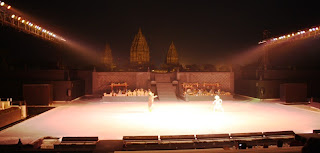
When a Nomad wanted to go and see the great Ramayana spectacle at the Prambanan it was time to jump in a taxi. It's about 30 minutes by car if traffic allows and that's not something you would ask a becak bicyclist to endure. Well the Taxi drive was almost more fun than the Ramayana performance...
After the obligitary "Where are you from?" my taxi driver jumped at the opportunity to practice his Dutch language skills on me. "Goedenavond menir!" But much more than that wasn't in his vocabulary yet, and we soon where chatting away in Indonesian. He really wanted to learn Dutch as he thought that there were already plenty people fluent in English. Listening to Dutch made him feel 'senang' and was surprised to learn that this Malay word was also used in the Dutch language.

"Saya suka behasa Belanda.", he says and he didn't care if that was politically incorrect. He was in his late 50's and probably a young child during the Indonesian emancipation, but was quite aware that the Indonesian identity was very much build on anti-Dutch sentiments. To him that was weird. Just look around he says when we drive down Marlioboro street. Look behind the big boards here, these are all still nice Dutch buildings. Further along the way he says: "Now look these ugly ones here are all ugly new Indonesian contraptions." "Modern", he adds with a smirk on his face.

This was a taxi driver with an outspoken opinion on architecture.

Soon we were hunting for Dutch words. Starting with 'mobil' and 'knalpot', Dutch words that are in fact not used anymore in the Netherlands. Then I see 'apotek' and 'kantor'. I think of the word 'atteret' (achteruit) that I had heard in earlier travels to the country. He mentions: "Dilarang masuk, 'verboten!' " and I'm surpised that this word 'verboden' is still used. Are these words actually in the 'kamus' I ask and he says: "No, its slang, I guess."

Now our eyes start scanning the streets and as in a game we shout: 'Notaris', 'Makelar', 'Klinik', 'Kelas', Laboratorium'. 'Stelsel', 'Grosir', 'Truk', Koperasi', 'Handuk', 'Es', 'Gelas', 'Sprei', 'Buku', 'Rokok', 'Amplop', 'Onderdil, 'Persnelling', 'Wortel', 'Kualitas', 'Polisi', 'Resleting'!

"Kamar!" "Tidak!" "Ya, betul, Pak."

There are many more Dutch words left in the Indonesian language than even my taxi driver realised...